Anna Brown
Killers of the Flower MoonAnna Brown was an Osage woman whose disappearance and murder in May 1921 exposed a conspiracy aimed at her family’s wealth. Her death was not an isolated killing: investigators later understood it as the first calculated move in a sequence that transferred family headrights toward her sister, Mollie Burkhart, whose husband, Ernest Burkhart, was under the influence of his uncle William K. Hale. Anna’s murder also became a measure of how carefully violence could be hidden behind familiar family routines, unreliable testimony, and the machinery of guardianship.
Identity and Family
Anna was thirty-four when she disappeared, less than a year older than Mollie, one of her three sisters. She was the oldest child in the family and held a special place in her mother Lizzie’s affections, though her temperament could be difficult. Anna was divorced and had no children. That fact would become consequential to the murder plot: her property could pass first to Lizzie rather than being divided among children of her own.
The sisters’ names were recorded on the Osage Roll, the register of tribal members, and their membership carried a financial stake in the oil beneath Osage land. As royalties grew, quarterly distributions that had once amounted to only a few dollars rose into the hundreds and then thousands. The family’s wealth therefore existed alongside a system in which outsiders could exercise control over Osage property. Anna’s financial affairs were managed by Scott Mathis, who also served as guardian to her mother, Lizzie.
Before Anna vanished, Mollie had already endured the sudden death of another sister, Minnie. Doctors had attributed Minnie’s death to a wasting illness, but Mollie doubted that explanation because Minnie had been young and healthy. The loss did not prove that Anna was in danger, but it shaped the family’s experience of absence: when Anna failed to return, Mollie was not confronting the possibility of death for the first time.
The Last Day Mollie Saw Her
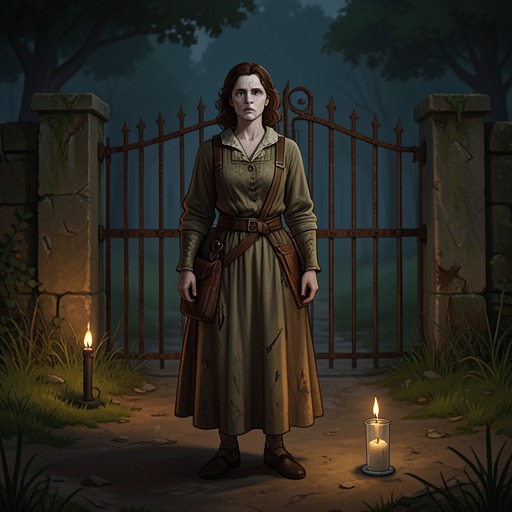
On May 21, 1921, Mollie was preparing to host a luncheon and had asked Ernest to see whether Anna would come help care for their ill mother. Anna arrived by taxi in bright red shoes, a matching Indian blanket, and a skirt, carrying an alligator purse. She had combed her windblown hair and powdered her face before coming in, but her unsteady gait and slurred speech made clear that she was drunk.
Her arrival unsettled the gathering. Anna quarrelled with Mollie, Lizzie, and guests; a servant later described a fearful, difficult scene. That evening, while Ernest took visitors to Fairfax, Bryan Burkhart offered to drive Anna home. Before she left, Mollie washed Anna’s clothes and gave her food. She waited until her sister had sobered enough to seem like herself again—bright and charming—and the two shared a brief reconciliation. Anna said goodbye with a gold filling flashing in her smile. The familiar details of that parting, from the clothes Mollie had washed to the filling in Anna’s teeth, would later help identify her body.
Anna had often gone on drinking and dancing sprees, sometimes staying out until dawn. The family therefore had an ordinary explanation for her absence at first. But she did not return after one night, or the next. Bryan said he had left her safely at home; when Ernest checked, Anna’s door was locked and the house appeared dark and empty. Mollie pressed the family to keep looking. Her anxiety grew as the days passed, while the possibility that Anna had simply gone elsewhere remained plausible because she sometimes travelled to dance and carried a small pistol in her purse.
Disappearance and Identification
A cabdriver later gave investigators a more intimate account of Anna’s last known journey. Before going to Mollie’s house, she had asked him to stop at the cemetery in the Gray Horse settlement. She walked among the graves to her father’s tomb, then asked the driver to send someone with flowers so that the grave would remain pretty. During the ride, she told him she was going to have a baby. The account establishes what Anna said, not what became of the pregnancy; the available evidence does not resolve that question.
About a week after she disappeared, an oil worker found a badly decomposed body in brush beside a derrick, about a mile north of downtown Pawhuska. Two bullets had been fired between the victim’s eyes. The body was so difficult to recognize that a letter in a pocket, addressed to Charles Whitehorn, initially led people to identify it as the missing man. Anna’s body was found separately, near Three Mile Creek valley, by a boy who had gone down a ravine after a squirrel.
The men at the creek could not identify the corpse. Scott Mathis contacted Mollie, and a procession formed to the site, including Ernest, Bryan, Rita Smith, and Bill Smith. Mollie and Rita recognized the Indian blanket and the clothes Mollie had washed, though the face was nearly unrecognizable. Bill used a stick to open Anna’s mouth; her gold fillings confirmed her identity. Rita wept and was led away. Mollie, who had kept her composure through the search, silently acknowledged the identification and left with Ernest. The murder transformed the family’s anxious uncertainty into a confirmed loss, and the discovery marked the beginning of a wider threat to the family and the Osage community.
The Investigation and the Inheritance Plot
Bryan’s account of taking Anna safely home did not survive the investigation. Witnesses placed him driving with her after the point at which he claimed to have left her. Investigators reconstructed a night that included stops at drinking places near Fairfax, with Anna and Bryan last seen together in the early morning. The emerging evidence established a crack in Bryan’s alibi, but the full account of what happened after those sightings remained uncertain until Ernest Burkhart identified the man investigators had been trying to locate: Kelsie Morrison, a supposed informant who had in fact passed information to Hale and his associates. Ernest said Morrison had fired the fatal shot.
Morrison later testified that Hale had recruited him to kill Anna and supplied him with a .380 automatic. He described Bryan as an accomplice. After Anna had been made drunk, Morrison and Bryan drove her to Three Mile Creek valley; Morrison’s wife, Cole, was in the car and was told to stay there. Anna was too intoxicated to walk, so the men carried her down into the ravine. Morrison’s testimony gave the killing a specific sequence and linked the men already present in the investigation to a larger plan.
The inheritance pattern supplied the plan’s financial logic. Because Anna was divorced and childless, she had left nearly all her wealth to Lizzie. Lizzie, in turn, had willed most of her headright to her surviving daughters, Mollie and Rita Smith. Investigators concluded that killing Anna first made it possible to concentrate her wealth through the next generation of heirs. The later deaths of Lizzie, Rita, and Bill Smith further redirected family assets, although Bill’s survival for several days after Rita’s death disrupted the intended distribution of some of her property. The bulk of the family headrights nevertheless accumulated with Mollie, whose wealth Ernest controlled.
Records also placed Anna within a broader system of financial oversight and suspicious deaths. A guardianship register listed Scott Mathis as guardian to nine Osage people, including Anna and Lizzie; seven of the nine had died. The number alone did not establish who was responsible for each death, but it showed that Anna’s case belonged to a landscape in which guardians could manage property while many deaths went uninvestigated. Later scrutiny of the cases also focused on doctors and others suspected of concealing evidence or facilitating the scheme, including the Shoun brothers, whom investigators associated with the disappearance of the bullet that had killed Anna.
Significance and Memory
Anna’s murder became a turning point in the investigation because it connected a specific killing to an inheritance strategy. White’s reconstruction made the family’s sequence of deaths legible as a design rather than a run of unrelated misfortunes: Anna’s death transferred the first major share to Lizzie, and the later deaths of other relatives pushed more wealth toward Mollie. The apparent intimacy of the method—using a nephew within the family and people who could pass as informants or helpers—made the conspiracy difficult to distinguish from ordinary trust until testimony and records began to converge.
Anna also remained present in the family histories carried by later generations. At the Osage ceremonial dances held each June in Hominy, Pawhuska, and the Gray Horse settlement, Margie Burkhart, Mollie’s granddaughter, spoke of the family losses inherited through the story of the Reign of Terror. Her father, James Burkhart, and his sister Elizabeth had grown up inside the house shaped by Ernest’s secrets. Margie remembered her father as haunted by what Ernest had done, while also recalling the tenderness with which he spoke of Mollie. Anna’s death was one of the losses behind that inheritance: a sister’s brief return home, remembered through the clothes her family washed and the gold fillings that finally made recognition possible.